I've had some bad shows in the past. Despite how badly things go, I take some pride in sticking things out. Other artists pack up and head out early, but I feel a duty and obligation to stick it out to the end. In general, I really don't even start packing up early, much less leave early. If things are going badly and I'm not very busy, I might start packing up some of the less important frames a bit early...like maybe if I get a booth where an outside wall is usable and I fill it with my extra "rarely sell" photos, I might start putting those away slowly over the course of the last hour of the show. Or if I've got those sort of photos inside the booth (like if I sold one of my frames/canvases and I use them to fill in the space), I might start putting them away 15 minutes early. But in general, I wait until the actual show end time to start packing.
However, all of that is now out the window. For the first time ever, a show went so badly, I felt the need to pack up not just an hour or two early, but more than an entire day early.
The show, and why I picked it
The show in question was the Fall Into Dearborn show in early October. It was a 3 day show...a 4 hour charity preview party on Friday evening, and 8 hours on Saturday and Sunday. I picked the show on a whim, simply because I had nothing else that weekend, it was close to home, and I wanted to give an indoor show a try.
Early signs of trouble should have been a clue
Early on, there were a few things about the show that should have indicated to me what was in store. First, the application indicated a booth size of 9'x9'. As anyone familiar with art show configurations knows, a standard booth size is 10'x10'. This should have been an indication something was odd. However, I wrote it off, as some indoor shows merely offer enough space for a table...maybe 5'x8'. I thought maybe this one was a being bit more generous, and figured I could work with 9'x9' with a few adjustments. It turns out they just didn't realize the configuration of a typical booth. They ended up rearranging and making the booths 10'x10' anyway after several artists expressed concern.
The application specified a date by which you would be notified of the acceptance or rejection. Yet, 10 days later I had heard nothing. I had to email the show organizer to get an email response confirming I was accepted. Shortly there after, I got a letter in the mail indicating acceptance and stating that I would receive more details in early September. Well, as of September 29th, I had received no followup info and once again had to email the organizer to get the info.
Also, on the application there was a box to indicate whether or not you wanted to donate an item for the charity auction, and it stated that donors would be given preference for booth selection. I checked the box and didn't think much more about it. Then, 2 days before the show I was contacted to ask what item I would be donating. I had no idea they needed to know ahead of time and thus hadn't given it any thought, so I said I'd need to think about it. I was told they would call back to get the details later that day or the following day, yet I never received a followup call. Needless to say, I never had an opportunity to give any input into my booth location. As far as preference, there seemed to be no advantage given to anyone in particular. In fact, the artist right next to had the advantage of a corner space (which was not a paid feature at this show), and they didn't even show up for the Friday preview, so I'm fairly certain they didn't donate anything for it.
What went wrong
The show officially started at 4PM. By 4:15, I realized where they had setup the auction and went over. I indicated that I hadn't been contacted about my item. Someone followed me back to my booth to accept it. While I was digging for it, they realized they didn't have an auction tag for me. They asked if I had called to let them know what I was donating. I told them they said they would call me but never did so. I was told to hold onto my donation for the moment. However, nobody ever came back to ask for it.
The Friday night preview party was a dud. It definitely seemed like less than 100 people showed up. I don't know what the actual number was, but from what I saw it seemed like maybe 50, and a lot of them were mostly standing at the front, not browsing artists booths. I ended up making a $5 sale to another artist, and a $50 sale to a show patron. That was it.
Oh...and about that auction. I took a look at a number of items and saw very few that received bids. There were at least 50 items up for auction. When the auction was over and they announced the winners, I wasn't paying careful attention but it sounded like no more than 10 items had been bid on.
In chatting with other artists that evening, it turns out I wasn't the only person who had received poor communication. Pretty much everyone else had the same problem. One person hadn't even been notified of their acceptance until 2 days before the show. Unbelievable.
What went wrong - day 2
Based on Friday's results, I had low expectations for Saturday. The show was set to start at 10AM, so I figured I'd show up around 9:30. I didn't imagine there would be many customers there for the first few hours (at least). Imagine my surprise when I pull in and couldn't find a parking spot. The main lot was filled. People were driving up and down isles. I had to park in the much less obvious side lot, and even then I had to walk a decent distance. I said "oh my gosh...this place is packed. They've got to be lined up at the door to get in". I practically ran to the room only to find it empty and nobody outside. So what were all the cars there for? Well, it turns out there were 1200 people there for a multi-level-marketing seminar, and they were using most of our parking. Apparently, the organizers had no idea that event was going on. Humorously, one of the artists was reading an article (I think it was in Sunshine Artist magazine) talking about how lack of parking will kill an art show.
However, the seminar turned out to be probably the best thing that happened. They took an hour lunch from 12 to 1. Since there was very little food offerings in the civic center, most people had to leave to get food (which cleared up parking for a bit, not that we needed it). However, a small number stayed there and visited the show. It was so few people, you'd never notice it at an ordinary show. However, these were virtually our ONLY customers, so it was welcome. I made 3 small sales in that hour, which (other than a sale to another artist) were my only sales of that day.
Discussing with other artist what had gone wrong, the topic of advertising came up. Someone had mentioned that there was a large LCD sign out in front of the civic center, and that the art show wasn't even listed on the sign. I went out and watched the sign for several minutes, as it went through the complete cycle 3 times, and there was no mention of the art show. When we informed the organizer, she insisted that it was being shown, and that she had seen it on her way to work every day for the last 3 weeks. However, when told that it wasn't there now, she went to check. She confirmed that it wasn't there, and claimed it had something to do with a power outage that occurred the day before (though I'm not certain how that worked, since everything else, including the 1200 person seminar, was being advertised). They needed to call someone in to reprogram the sign but had no idea when it would get done (I suspected they wouldn't be able to get him in on a weekend).
Also on the topic of advertising, one patron had mentioned she heard about the show on the TV news. Great, right? Well, according to her, it wasn't even clear that the show was taking place indoors. She had understood it to be an outdoor event, and with the rain coming down she hadn't intended to come. It was only because there was a break in the storm that she decided to come check out the show...only to be surprised to find it indoors. I wonder how many others made the same mistake, and either didn't come because of the rain, or simply couldn't find the show because they were looking for a bunch of white tents.
Talking with other artists, very few of them had just barely made back their booth fee. Many hadn't received a single sale at all. I walked around and did a booth count, and came up with about 45 artist booths (there were a few more that belonged to the community art center, which I didn't count). With the show scheduled to run until 6PM that day, at about 1PM, the first artist began packing. About every 15 minutes after that, I did a walkaround of the show (yes, it was so empty, I had zero concern with leaving my booth empty while I took a brief stroll), and each time I found another artist packing up. Sometime by about 3:30, there were now 11 artists who were either gone or in the process of packing up. Several more indicated intentions to pack at the end of the day, or to come pick up their stuff Sunday morning. My estimate was somewhere between 25-50% of the artists would not be there for Sunday.
At that point I called my wife up at 3:30 and said "I've never done this before, but I'm seriously considering leaving". I told her I'd call her back in an hour with a decision, and she said she'd come help me pack if I decided to leave. In that hour, virtually nobody showed up, and my only sale was to another artist. I tried hard to think of a reason to stay but could come up with nothing. Almost nothing had gone right, and on top of everything else, the show was destined to look like a ghost town on Sunday.
It was a decision that was a bit difficult to make. It involved a conflict between pride and practicality. In the end, practicality won out. At 4:30 I made the call and asked my wife to come help me pack. By 6PM, my trailer was loaded just as the show was ending. As I made my final walk towards the exit, I looked out the window of the civic center to see a lovely double rainbow. It was almost like a sign to me that I was making the right move. Here's a picture (and by the way, what you are looking at here are all that remained of the 6 or so booths that were along the back wall).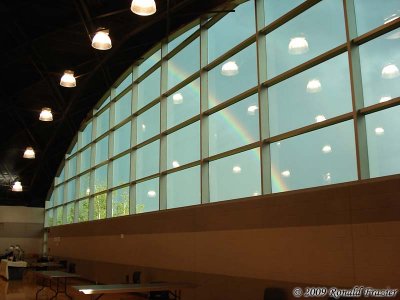
Day 3
Although I wasn't there, I knew another artist who stuck around. I was told that there were about 10 artists that didn't leave. Everyone spread out and gave themselves double booths to make it look more full (one artist spread his sculptures out over 4 spaces). Apparently hardly anyone showed up that day. There was a marine reserve symphony at 3PM, and a bunch of people came for that, but very few of them came over to the art show. In short, I'm absolutely certain I made the right decision to leave. I had much better ways to spend an entire Sunday.
What went right
Setup for the show was actually pretty straightforward. We had a few doors we were able to pull our vehicles right up to and unload right into the room where the show would be held. Setup went more or less without a hitch. From that aspect I had nothing I could complain about.
At the preview party, they had a nice food/drink offering for the guests which was also made available to the artists. There was a good variety of food from a number of local restaurants. At least I got something good out of it all.
Other than that, the only things that went right were my decision to leave, and a group of very friendly artists to spend the weekend chatting with (except for one lady who was a member of the community art center and tried guilt tripping the people who packed up early).
Conclusion
The booth cost $160 + $15 jury fee. I sold $167 in merchandise (and $65 of that was to other artists). I didn't even recover the fees, much less gas, materials, and time spent. Wow. That's a heck of a way to end out my art show year. This will certainly be memorable.
...click here to read more!
Sunday, October 11, 2009
Packing early...I've surrendered my badge of honor

Tuesday, September 15, 2009
Organizing with Propanels and Velcro
I've had my Propanels for 2 summers worth of shows now, and I'm absolutely loving them. As I wrote about last summer I've gone crazy for Velcro with the Propanels. In that article, I wrote about some hooks I made. Well, I've found another way to make use of them...organizing my work area. 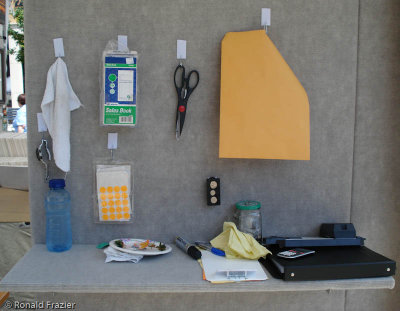
What you are looking at here is the back side of the back wall of my booth (the area out of sight from the customer). This is where I do all my work. When I ordered my propanels, I had 2 of the panels fitted with shelf slots. One of those shelves is in my booth with some materials for the customer to view. The other panel is along the back wall and turned around, so the shelf can be setup on the back outside wall. I use this to write receipts, stack up some of my supplies, assemble gift cards, etc.
Well, I also took some of my extra hooks and started using them to hang up some of the things I use often but want to keep out of the way. Scissors and a pack of price stickers hang directly on the hooks. My receipt book and knucklebuster slips are in a plastic pamplet holder, which is hung on another hook. I also hang up my watch when I don't feel like wearing it, as well as a damp cloth for cleaning things (or at hot shows, I soak a rag in cold water to help keep me cool...and I hang it from a hook below the shelf so it doesn't drip on the shelf). I also hang a garbage bag from a hook placed below the shelf. My calculator (seen here sitting on the binder) also has velcro on the back so I can keep it out of the way when not in use. I also have a few card that I velcro to the wall. One is a business card, so customers can see how to spell my name when writing out a check. The other is a list of credit card instructions, for when my wife it watching the booth, so that she knows how to make a credit card sale.
...click here to read more!
Sunday, July 26, 2009
Square cement weights
One of the most common ways to weight down your booth is with the round PVC pipe filled with cement. Several years back I posted a how-to on the topic: PVC and cement corner weights. At the Northville show last month, I saw an interesting variation on the design. The weight was square.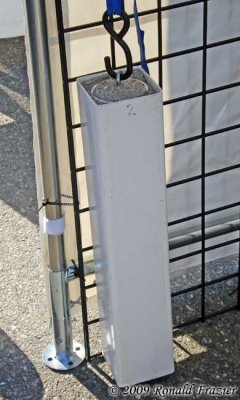
The artist that had these had originally made the weights from round PVC, but she didn't have any handles on them, and she got tired of them rolling. So she found the square tube, put her existing weights inside the square, and filled the gap with cement.
Although she wasn't sure of what the tubing was from, I'm pretty sure they are meant for vinyl fencing (you use a 4x4 wood post, anchor it in the ground, then slide on the vinyl tube). This means the tube itself is probably made from vinyl instead of PVC. I'm not sure what implications that may have for strength and durability. It might be thinner and crack more easily, but I'm not sure that would be a problem once it's filled with hardened cement. However, if you do decide to put handles on them to help with carrying, that might be a bit stressful on the vinyl. It might be a good idea to make sure the bolts are long enough that they stick quite a ways into the pipe. That way when the cement dries, the handles will be anchored to the cement more than the tube. You could also do the 2 nuts + 1 washer thing like I did for they eye bolt if you are concerned.
There is also the issue of how to seal the bottom. Round PVC piping has nice caps you can put on the end and seal with PVC cement, but for fencing, the caps I recall always seem to be decorative. I'm not sure what options you'd have there. If you can't find a nice, simple, flat end cap, then you might have to resort to custom cutting a piece of wood, some styrofoam, or whatever works, and then finding a way to prop up the tube really good so that when you fill it with cement the bottom doesn't fall out. If you use a thick enough piece of wood, you could drill some hole and screw through the tube and into the wood, holding it in place. You then may have to caulk it to seal it (I'm not sure how easily cement would leak through a crack).
Remember, I've never tried this, so I can't vouch for how well it will work. If you decide to try it, you are on your own. Maybe my concern about the strength of the vinyl isn't warranted and it would work great. Whatever the case, if anyone does decide to try this, send me an email when it's done (with maybe a photo or 2) and let me know how it works out and how you sealed the bottom.
...click here to read more!
Saturday, July 25, 2009
Catching up for 2009
It's been quite a while since I updated, so what have I been up to? I spent a lot of time enjoying myself, catching up on other hobbies, getting some stuff done around the house, all with some photography thrown in here and there. But as of June I'm stepping things back up again.
Late last year I upgraded to Lightroom 2.0 and discovered that my computer was way too slow to deal with it. So, this April I built a new computer and everything is running great. In June I took a trip to Yellowstone/Grand Tetons (and hit a few other places along the way), and although the weather wasn't the most cooperative for the photography I wanted to do, I managed to get by (though I got almost nothing in the way of sunrise/sunset, unfortunately).
I did my first show of the year in late June...the Northville Art in the Sun show that I was at last year. Whereas last year was pretty darn bad (just about broke even as I recall), this year was alright. Not superb, but better than a lot of shows I've done recently. I dropped the Livonia show I usually do in early June, as it has been absolutely terrible the last 2 years and I wasn't very thrilled with the way they were running the show. In exchange, I picked up 2 shows in mid September and early October, so I have 6 this year (and maybe more...I'm considering picking up 1 or 2 in Nov/Dec if I can find something worthwhile).
That about covers it for the most part. Not a whole lot beside just working on some new works, printing, matting, etc. I'm trying not to change a whole lot this year, as my goal is to keep costs down and try to actually turn a profit this year. I've been taking losses up to now because of how much money I had to spend between supplies, my camera and lenses, my wide format printer, the new booth and panels, etc. If I stick to the basics and most of my shows go decently, I'm hoping I can make it. It's not easy, as I'm always researching and thinking "I could buy this to make things easier, or build this thing to help organize things, or buy that to make my display nicer". For someone who is continually searching for ways to improve everything, it's not an easy thing to do, but I'm trying to restrain myself.
...click here to read more!
Friday, October 31, 2008
I'm no longer accepting American Express
I've decided to no longer accept American Express credit cards at my shows. After long and careful consideration, I've decided it just isn't worth it. I originally signed up for American Express after hearing stories from another artist who said large sales increased after he started accepting AmEx. I was hoping it would do something similar for me, or at the very least, have zero impact. Instead, what it has done is increase my expenses.
When I first signed up for AmEx, I was allowed to sign up under a plan that would only cost me a small percentage of each sale. It was comparable to what I was getting for Visa/MasterCard/Discover, so I was happy to take it. In that first year, only got a few sales with AmEx. One was from a friend, and the other was from a lady who had nothing but an AmEx card on here (which she humorously carried between her breasts). That was only a $20 sale, but it was $20 I wouldn't have received otherwise, so I figured it was a good thing I decided to go for AmEx. For the rest of the year....that was it for AmEx.
By the second year, AmEx forced me to switch to a flat rate plan, which mean I would be paying $6 a month, but nothing more. I figured I'd stick with it. However, I started an experiment. Everytime someone payed with an AmEx card, I'd ask them a what if: "I'm just doing a survey of my customers. What if I didn't accept AmEx? Would you have had another way to pay?" For the rest of the year, in every single case, the answer was yes. So, it was looking like AmEx wasn't gaining me a thing. Yet, for some stupid reason, I didn't have the guts to stop carrying the card, so I continued to pay the fee.
This year was year 3, and I continued my experiment throughout the year, with exactly the same results. If I were to drop AmEx, it would cost me nothing in sales. However, this year, AmEx did something different. They started charging me a fee each time I had an AmEx transaction (on top of the flat rate fee).
Enough was enough. American Express gained me absolutely nothing in sales (other than $20 one time), and cost me quite a bit in fees. It made absolutely no sense to accept the card, so I cancelled my account with them. When I called, I thought I was going to have to spend a bunch of time, talk with a rep, and maybe get offered some sort of deal to continue carrying it. However, the automated system had a menu option explicitly for canceling (a rare feature with automated phone systems these days), and I was able to cancel without speaking to anyone.
It's sad that about the best thing I can say about my whole AmEx experience is that it was painless to cancel.
...click here to read more!
Wednesday, October 29, 2008
2008 was a bad year for sales
It's been a while since I posted much. I've got a number of things to post about. I'll try to get to them over the next few weeks. However, for now, I just want to touch on how my art shows went this year. In a few word: not too good.
This year, before things even got started, I could see the writing on the wall with the economy (especially here in Michigan), and I wasn't too confident that things would go so well. So right from the start, I tried not to get my expectation too high. That was a good thing, as most of my shows went quite poorly. My only consolation was that I wasn't the only one doing bad. At each show, it was the general consensus among artists that things were bad. So it's not me. That's good to know, though I'm not sure what to do with that knowledge.
I examined my schedule from last year, and decided I wasn't going to add any new shows. I decided just to take the best of last year and eliminate a the bad parts. There were 2 shows that were outright terrible. However, one of them (Livonia) I had made the mistake of prepaying for the year before, so I was stuck going anyway. The other one (St Clair), however, got eliminated. Another show (Wyandotte) was actually reasonably profitable the year before, but it was such a long, drawn out show, that the number of hours I end up investing was just huge in proportion to the profit I made. I reluctantly eliminated that one from the list. Finally, the Troy show was also a pretty decent one day show the year before. However, now that I had a new booth setup and it takes a little more time setting up, I wasn't confident yet in my ability to be able to finish during the small setup window available for this show.
What I was left with was Livonia, Northville, Sterling Heights, Shelby Township, and South Haven. Much like last year, Livonia was a disaster. This time I was smart enough not to pay for next year. I won't be going back. Northville and Shelby Township were my 2 best shows last year, but this year I barely got a tiny profit out of them. In Sterling Heights, my sales were less than half of the previous year. Yet, when you consider that the booth fee was the same, and gas prices were higher, my actual profit was only about 25% of what it was the year before. Very discouraging. South Haven was the only show to do well. My sales total was within $50 of the year before.
When it was all said and done, the 5 shows I did this year actually got me about $400 LESS than the 5 shows I did in my first year (2006). Ugh!
So where do I go from here? At this point, it's looking like 2009 may be even worse than 2008. With a presidential election coming up very soon, I think the outcome of that may have an impact on how next year turns out. In either case, I don't think we are going to see a massive turn around too quickly. However, it seems one candidate does have the ability to inspire people, and inspiration can be a wonderful thing in making good things happen. But other than that, I'm not seeing a lot of promise. I'll have to evaluate a lot of different things, decide which shows I might want to keep as my cornerstones, and which ones to replace. Perhaps I'll think about why it is that South Haven did so well and see if I can come up with other shows like it (easier said than done).
The one good thing I can say is that I've got a lot of my expenses out of the way now. Overall, I'm very happy with the booth setup I have (other than I'd like to make some new print boxes...an item on my list for this year that never got done). I've upgraded my camera and lenses this year. Next year I'm hoping I'll be able to keep expenses to a minimum and actually turn a profit for once.
...click here to read more!
Sunday, August 03, 2008
Interacting with customers in your booth
In the course of an art fair, many people will come into your booth. As they enter, they typically know very little (if anything) about what it is you offer. As the manager of your business, you need to decide how to introduce your customer to your work. Opinions on the topic vary greatly, ranging from sitting in a chair on the other side of the street doing nothing, to standing in the booth and greeting each person individually. There is no right or wrong way to approach the matter (though I do have my opinion). It really is someone of an art, and it also depends a bit on your comfort level and even your personality. So how do I approach the topic?
When most people come in, I wait for someone to make eye contact. The people that really just want to keep to themselves will usually try to intentionally avoid making eye contact, so you can take this as an indication that they don't care much to be bothered. Once they do make eye contact, I greet them (hi, how are you) and then I give them the 10 second introduction: "This is all photography done by me and my wife. I do all of the printing, matting and grooving, the canvases, and everything. If you'd like to know more about any of the photos I'll be happy to tell you about it."
It may seem a bit monotonous and repetitive, especially when you've heard yourself give it a few hundred times, but remember that they've only heard it once. To them it's fresh and welcoming. Plus, it tells them everything they need to get the gist of my business:
1) It is photography (not paintings...a common point of confusion).
2) I'm extensively involved in the product creation (not just selling merchandise).
3) I can tell you all about the products I sell.
4) I'm interesting in answering your questions (rather than just sitting in a chair across the street until you pull out your wallet).
If somebody was already in my booth when I gave someone else the speech, I assume they overheard and just let them browse without repeating myself. If they seem to get stuck on any photos (perhaps trying to figure out what it is or where it's from), or when they reach the end of the print bin, I usually greet them with "hi, did you have any questions about any of the photos?". Usually they'll say "no, I'm just browsing" but every now and then you'll get a "yeah, I was wondering what this photo is".
Sure, it doesn't make it as easy of a job when you have to be a salesman all day rather than just a cashier. I don't have any scientific data, but it sort of seems that I sell a little more when I talk to people a lot. I've managed to give people info about pictures (info I'm fairly sure they wouldn't have asked me about if I hadn't volunteered it) that caused them to purchase it. In one instance, traffic was a bit dead and I spent 15 minutes talking to one customer, discussing a dozen different photos in great detail. When we were done she was so excited about everything I told her and said "I want to thank you for spending so much time with me, and I'd like to buy this photo".
You might think 15 minutes is a lot of time to waste on one customer, but I had little else to do, and it really helps break the monotony of sitting there waiting for the next sale. If I can't be making sales, I'd rather have a conversation about my work with someone genuinely interested than to be sitting there noticing exactly how long it's been since my last sale.
...click here to read more!
Friday, June 27, 2008
ProPanels - Velcro is the new duct tape
About a month ago, I received my new propanels to replace my old homemade panels made from electrical conduit + grid wire. I got to use them for 2 shows now, and I must say I like them a lot. They look so much more professional than the old burlap covers I made for the homemade panels. They setup so much easier, are more rigid, and a tiny bit lighter in weight. But the biggest thing I like about them is that Velcro sticks to the carpet. Even in just this short time, I've already realized that velcro (or more generically, hook and loop fastener...specifically the hook side) can be used for just about everything. In fact, I've already gone through a 75 foot roll of hook velcro and just ordered 2 more rolls.
Hanging artwork
When I got my panels, the first problem I needed to solve was how do I hang my work? I used to use curtain hooks that went through the burlap an over the grid wire. You can use the same on propanels, but they have no internal grid, so the hook is really just supported by the carpet. The problem here is that it will stretch the carpet out. From my understanding, that's not a problem because the carpet will return to normal after it sits. However I've seen it done and it looks a bit unattractive, because the picture leans out a bit and you can see it stretching away from the wall.
Another option is the hangers that you can buy with your propanels. They hang over the top and extend down as far as you need. I shot this down for a number of reasons. They cost a fair bit of money, they are a little limiting in how you hang photos, and they don't look as nice since you see the hanger running down the panel.
Instead, I thought I'd try a different approach: velcro.
Canvas wraps
Since I was going to be showing a number of canvas wraps this year, I figured "those are pretty light...what if I tried hanging them with velcro?". I went and got a roll of sticky backed velcro, attached it too back of the finished canvas wrap, and hung it. It worked like a charm. Easy to hang up and easy to take down. The sticky backing on the velro has excellent adhesion. However, just to be safe, I put 3 staples in each strip of velcro (one on each end, and one in the middle). The canvas is very secure. In fact, if anything I overdid it and made it too secure. It sticks to the wall so good, it takes a concerted effort to remove it (but still, no more than 5 seconds)
Here's a photo of the back on one of my canvases. As you can see, I put a strip of velcro across the top and bottom edge of the wrap, and then just a small peice on each edge. For as light as these canvases are, you could probably easily get away with only half as much velcro.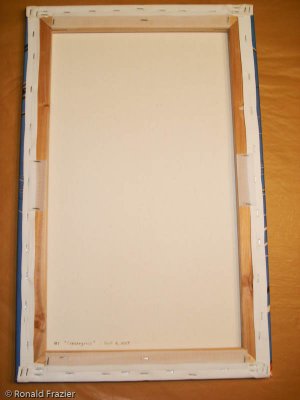
Back of a canvas with velcro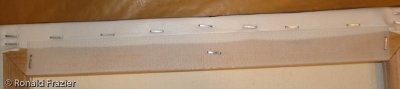
Closer look at the velcro
The thing I like most about this design is how easy it is to hangup frames in the booth. In 2 seconds I can have the frame right where I want it. In addition, the frame isn't going to shift when things get windy and the booth rocks...no more periodically straightening frames throughout the show.
Hanging wood frames
Well, I thought if this worked so incredibly well for wraps (which are just wood) they should work equally well for regular wood frames. My heaviest work is a 24x36 with acrylic instead of glass, so it only weights about 12 pounds. I did the same thing with my wood frames, and it worked like a charm. 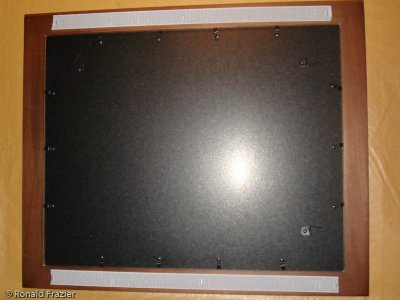
Wood frame with velcro
Pictured here is one of my 16x20's. It holds well with just the 2 sections of velcro. For my larger, more expensive pieces, I wanted to be extra careful so I put a lot of velcro on the sides as well.
Hanging metal frames
Now came the tricky part: hanging metal frames. With such a thin surface area to adhere to, and without being able to staple the velcro to the frame, I was extremely apprehensive about taking the same approach. After thinking about it a bit, I thought "what if I made a short piece of velcro and put curtain hooks through it". It would be just like the old way, except instead of piercing the hooks through the wall, I'd velcro the hooks to the wall.
In designing these, I had a few concerns. First, with the weight on such a small piece of velcro, I was concerned about it coming off. If I attached the hook up high on the velcro, the weight of the picture would in effect peel the velcro off from the top until the whole thing comes loose. If I instead attached the hook to the bottom of the velcro, the weight would pull the velcro down instead of peeling it off. Since the velcro doesn't easily slide across the carpet, that would solve that problem for all but the heaviest frames (much heavier than anything I display).
The other concern was that if I punctured the curtain hook through the velcro, the weight could cause it to tear through the velcro until it breaks loose. Of course, the velcro I'm using is quite tough, but still better safe than sorry. I decided to simply re-enforce the hole with a metal washer.
Making these hangers was quite simple. Cut 2 identical size pieces of adhesive backed velcro (one piece hook, the other loop). Take one piece and peel off the backing. Take a tiny metal washer and place it about 1/4 inch from one end. Then take the other piece of velcro, remove the backing, and stick it perfectly to the first piece. Once it's stuck together, it should be an extremely strong bond, and the washer should be firmly in place. Now take a curtain hook, puncture the velcro with the sharp end (making sure to puncture through the washer). You may need to use pliers to bend the hook some so you can put it through the velcro, and then bend it back to its original shape after it's assembled.
Now you've got your finished velcro hook. Just make a bunch of these, and use them to hang your frames (I use 2 per frame).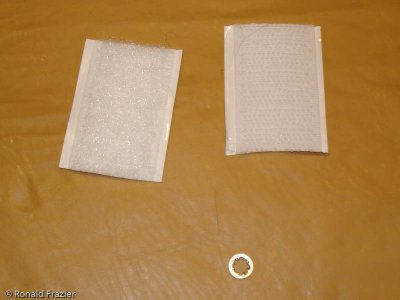
Parts needed (plus a curtain hook)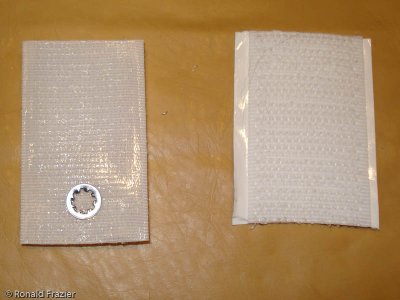
peel off the backing and place the washer
Carefully attach velcro, adhesive backings together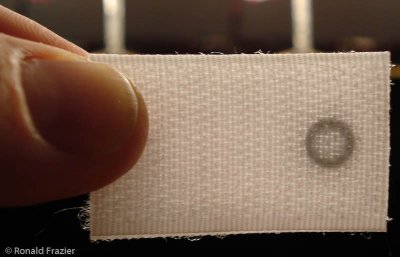
Finished strip, backlit so you can see the washer inside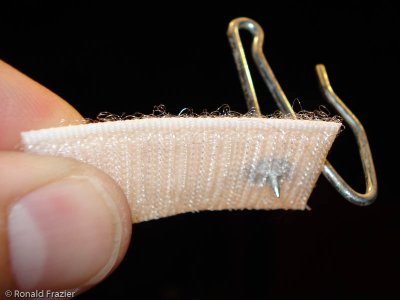
Puncture the hook through the washer (make the hook side is down)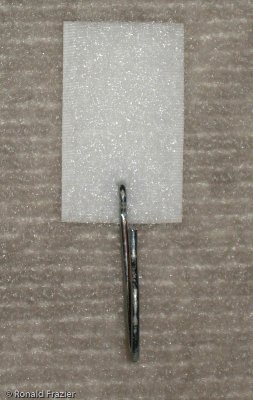
Finished piece on a propanel.
Getting these cut perfectly the same length so that none of the adhesive is exposed can be a bit tricky. What I found to work better was to make a dozen at once. Peel off a couple feet worth of loop velcro, stick a dozen washers to the back (evenly spaced every 2 inches), then attach the hook velcro to the back of it (peeling as you go, so that it doesn't accidentally get stuck to anything. When you are done, you have a 2 foot long strip. Cut it every 2 inches, near each of the washers.
Hanging everything else
Next I figured if I'm using Velcro for the heavy things, why not the light things, too? Anything that I wanted to put on display was promptly stuck with velcro. Price signs, credit card signs, information plaques, etc. Anything in my booth...if it was attached to my propanels, it was done with velcro (with one exception...my shelves where attached by shelf brackets, but I'm sure I could figure out how to velcro those too if I had the need).
Where to get velcro
I found my velcro cheapest on ebay. Look for 1" wide, adhesive backed, 25 yard (75 foot) rolls. If you buy 2 rolls together, you should be able to get them for about $20 a roll shipped. The first order I got 1 roll of loop and 1 roll of hook. I hardly used the loop, but I finished off the hook rather quickly, so my second time I ordered just 2 rolls of hook.
If you don't want to order through ebay, the company that I bought from sells direct. Their hook-and-look can be found at http://www.baerfabrics.com/hook-and-loop-fastener.asp
...click here to read more!
Monday, June 23, 2008
Next show only slightly better
I had another show this week. This time it was the Northville Art in the Sun show. The gist of it is, I did a bit better...made a small profit, but still nothing to get excited about.
Setting Up
This was attempt number 2 at setting up my new booth. Unfortunately, this show only had a morning setup (no option to setup the night before). On top of that, my wife ended up having to work at the last minute, so I was doing things on my own. And on top of that, I only had about 4 hours of sleep.
Then on my drive in, I literally missed hitting a deer by about 2 feet (the driver next to me hit the second deer). In fact, I would have hit the deer I missed had I not mistakenly thought the lane I was in was ending and thus cut over 1 lane. The scariest part was that I didn't even see the deer coming. When I realized I shouldn't have cut over 1 lane, I looked in my passenger mirror to make sure the lane was clear, and as soon as I looked back forward, the deer was already in front of me. I slammed on the brakes and she just barely got out of the way. As I'm trying to stop, the deer carcass from the other car is sliding down the hiway at the same speed as me, spinning in circles as it slides. I was just hoping it wouldn't slide into my lane before I stopped.
Well, despite being alone, and then very freaked out, it didn't work out so bad. I put a few parts on backwards, and a few other mistakes, but I got everything together fine.
The show
Traffic was a LOT better than Livonia. Not even any comparison. There were a few dull spots, but mostly it was good. The slow periods mostly corresponded to the rain. A medium rain came in about 1 hour before the end of day 1. Then there was lightening about 15 miles away and reports of hail at another nearby city. Some strong gusts of wind came in. An artist a few booths down selling wooden bowls was in the middle of securing her canopy side walls when the wind grabbed it, hit her display, and destroyed $700 worth of work. Everybody started packing up. After being one of the few holdout artists, I decided enough was enough and closed up 30 minutes early (the first time I've ever done that at a show).
Day 2 was very similar. Similar traffic (perhaps slightly better). Similar gusts of wind, and threats of rain, but nothing much came of it. Happily, since no rain came, my tent was able to dry out, which means I now don't have to unpack it at home to let it dry out.
The sales
Well, it was better than last time. At least I made a profit (though remarkably tiny, after deducting booth/app fee, materials, and gas). I figured I worked 22 hours this weekend for about $3 an hour.
I wasn't the only one doing poorly. Everyone else had similar complaints. I saw very little artwork in patron hands. The number of people I saw walk past carrying photos from other photographers...well, I didn't need 2 hands to count them. The market just wasn't there
Conclusion
A slight turnaround, but still disappointing. But it was a fun experience. At least now I know I can setup the whole display (9 foot trimline included) all by myself (with just a tiny bit of help putting on the legs). I figured out some cool new ideas for my setup. I've got 5 weeks until my next show and a number of ideas to consider implementing before then. Hopefully then things will turn around a bit.
...click here to read more!
Thursday, June 19, 2008
Starting off year 3 with a terrible show
Once again I'm off to a bad start for the year. Last weekend I did the Livonia Art From the Heart show, for the third year in a row. It ended up terrible...I lost money. However, it was good practice with some of my new equipment, so not all is lost.
History of Livonia Art From the Heart
Just to recap a brief history, Livonia was my first show ever, and ended up as my best show the whole first year. The second year was a LOT worse. I actually lost money that time and it was my lowest sales show of the year. However, at the time I did the show, I had not yet experienced a better show, and so (not knowing what was out there) I was too quick to just write it off as a bad year and thus signed up for year 3 on the spot (in order to get a $50 discount). Well, year 3 turned out just like year 2.
Way fewer artists this year
When I received my welcome packet a while ago, the first thing I noticed was the layout of the show. The isles looked like they had way fewer booths than last time. This time there were less than 100 booths, whereas (I believe) the prior year had about 150 booths. Obviously a lot of people were upset about 2007 and didn't return.
When I arrived on Friday night to to check in, the thing I noticed was that they were hand writing in several people onto the show layout chart and filling out their signage by hand. In contrast, most everyone had them prefilled in and computer printed. It's possible these were alternates called in at the last minute. However, given the decrease in the number of booths, I don't think that was likely...I suspect they actually accepted everyone who applies. The only other thing I could think was that they were actually accepting last minute entries.
One benefit of the fewer artists was that our booth space was increased from 10x13 to about 15x13. That would have been useful had I realized it before I finished setting up...I could have put up another awning and put some more work on the outside wall. Oh well.
Friday night setup...in the rain
When I arrived to setup on Friday night, it had just started raining. On the plus side, we missed the lightening that was originally forecast, and the rain was only relatively light...no downpour. Normally I would have been upset about the rain, but this year I had my new Trimline canopy. If it were as good as its reputation, I'd have nothing to worry about. Another upside to the rain was that we were one of only about 6 people who chose to setup on Friday night, so there was no fighting for parking spots.
Even though I bought the trimline at the end of last year, I never used it because I wanted some more practice setting it up. The only setup I had done before, I got as far as assembling the frame and top, but no walls or awnings. Well, I never got around to practicing, so essentially I was doing my first whole setup of the tent on the spot. I ran into a few small snags, but nothing I didn't quickly figure out. I'll write more about the booth in another post.
Once we got the canopy up (including walls), we were much relieved, as we were able to finish our work in the dry interior. We setup the pro-panels (which we also had never setup before), hung a few frames, and then decided we were exhausted enough to head home and leave the rest for tomorrow morning.
The show
Saturday was entirely uneventful. No rain, no major traffic, no snags. Nothing interesting to report on at all. Sunday started out the same way. Then there was a minor surge in traffic that made it hopeful that things would start picking up, but it ended as quickly as it started. A few more brief surges happened over the next few hours, but it never went anywhere.
There was a storm scheduled to come in right around the time we were to close (5PM), but it arrived early. At 1:30PM the storm hit. I closed up the booth, but there was lightening, so I figured it was safest to retreat to the car. The rain lasted only about 15 minutes. I returned and reopened.
The early exodus
Right after the rain, artists immediately started packing up. Our row held the line (we only lost one booth), but the next row over lost all but 3 booths. About 3PM I decided to take a walk around the show to see (what was left of) the other artists. It was sort of embarrassing how quickly I walked the entire show. There was hardly anything left.
It got a bit windy, and one of the artists who was packing up had her easy-up canopy roll on her. She made the mistake of leaving it up with no weights and no stakes holding it down.
The results
When it was all said and done, I made about $190 in sales on a $200 booth fee, so I lost $10 plus materials, gas, credit card fees, and time. What was most interesting was that even my cheap $5 gift cards couldn't save me. I sold a set of 5 and a single card. Three of the prints I did sell were discounted prints on my clearance shelf (I had too much inventory for my bin and wanted to move some of the older prints).
Another artist near me only sold a bit over $500 worth of stuff, and $325 of that was due to to a single large canvas sale. A jeweler near me only made $35 on Sunday.
Done with the show
I was a bit stupid for signing up again, but now I know better. I've found better shows, and there's no need to hope for a turnaround on this one. I'd rather spend my time trying out new shows than come back to this one, so that's another show off my list for next year.
Next up...the Northville show this coming weekend. Also up this weekend....a forecast for scattered thunderstorms :-( On the upside, maybe all this rain (if it keeps up) will make for a wonderful display of autumn colors this year. That upside is 4 months away. I must be desperate for good news.
...click here to read more!
Monday, May 26, 2008
Color Correction with the Datacolor Spyder 3 Studio
In getting ready for another year of art shows, I'm addressing some issues I faced last year. One of those issues is a lack of color consistency throughout my workflow process. Last year I learned all about color profiling and got OK results by using generic paper profiles from various sources. This year, I've decided to address the issue further. After researching various options, I decied to try out the Spyder 3 Studio from Datacolor. So how has it turned out? So far so good....
A brief history of my color workflow
For years, color correction was a non-existent topic for me. What I got out of my Canon i960 was mostly close enough for my satisfaction. If not, I'd tweak the photo in Photoshop to give me what I wanted. That "worked" well enough (only because my definition of "close enough" was pretty lax) until it came time to upgrade printers.
When I got my Canon IPF5000, I decided if I was going to spend over $1500 on a printer, I was going to do it right and learn how to use color profiles. I used generic color profiles from a variety of sources. That worked a lot better, but I found myself results still lacking. For one, none of the prints matched my monitor exactly. Second, I still found every profile gave me (at best) slightly different results. Some of the profiles that I got straight from the paper manufacturers were outright terrible.
Making the move to custom profiles
Over this last winter, I decided that from here on out, I needed to do things right and get custom profiles made. I had debated about paying to have them made, but I decided against it for a few reasons. The thought of paying out money for something like that just didn't strike me right. I'd rather pay more up front and then have the flexibility to create profiles whenever I wanted. I tend to like to experiment with different papers, and this gives me the option to create as many profiles as I want on a whim without wasting money. Any new paper I want to evaluate can be evaluated using a properly made profile, so theres no need to waste money, or to decide on a paper based on non-representative results.
I looked around at various options. The i1 Color from X-rite is well regarded as the leader in color management solutions, but in the $1000+ range, it was a bit out of my budget. I was looking for about half that price. I found a few solutions, including the x-rite ColorMunki and the Datacolor Spyder 3 Studio. From reviews, both seemed to do a good job, but the ColorMunki seemed to be a bit too basic for my tastes.
I decided to go with the Spyder 3 Studio. I found it through Amazon.com for only $545 shipped. It included both the Spyder 3 Elite (for profiling your monitor) and the Spyder 3 Print (for profiling your printer/paper).
Profiling my monitor
The first step of the process is getting the colors on your monitor corrected, so that your workflow begins with a known configuration. Otherwise, getting the print to match your monitor is both next-to-impossible and pointless. I installed the software for the Spyder 3 Elite and gave it a go. It was relatively painless. However, when I was done, I ended up with what I thought was a terrible monitor profile. The screen had a definite magenta cast to it. I repeated the process and got identical results.
At this point I was feeling like I had purchased junk and was about to say screw it and just make my monitor look good again. However, I remembered that it sometimes takes your eyes a while to adjust to different lighting, and thought maybe I should give the profile a chance to sink in. After about 10 minutes the color started to look really natural. Moving to a different light source and then coming back, I could see the magenta cast each time, but my eyes quickly readjusted. After a few days of working with it, somehow my mind has gotten adjusted to the new color settings, and now, even after coming in from a different light source, I can't really notice the color unless I'm consciously looking for it. Almost instantly, it looks like pure white to me.
I don't believe I saw any tips like this in the program. It would probably be useful, to set new user's mind at ease.
Profiling my printer
Now, with the monitor calibrated, it was time to move onto the printer. I started with my Canon HW Satin paper. I printed a basic 225 patch target and scanned it in. The scanning is a bit time consuming and tedious, but the included guide makes it easier and less error prone. After scanning in all the patches for the target, it generated a profile and I went to print a test page. When I hit the soft proof button, it showed very little change, so I figured that was a good sign. When I then printed it out, what I got was quite surprising. For the first time ever, my print looked virtually identical to what I saw on the screen. This was really a breakthrough moment for me.
Next I moved onto the "paper" that previously gave me the most problems: the Breathing Color Chromata White Matte Canvas. Breathing Color doesn't have a profile available for the iPF5000, but they do for the iPF8000. Being that the 2 printers are nearly identical (same ink set, same print heads) the profile should have worked fine, but it didn't. It had terrible contrast and saturation, so I had to correct for that in the printer's export module configuration. I was hoping the Spyder 3 Print could do better.
I printed out the 729 patch color target plus the 238 patch extended gray target. Scanning the nearly 1000 patches took me somewhere in the range of 30 minutes. As I got a little way into it, I was noticing that the results for each patch as displayed on the screen was quite terrible. Like my previous profile, they were all low in contrast and saturation. When I finished, I soft proofed my test print and it was horrible...much like what my uncompensated prints with the old profile had given me. I backed up and experimented a little with the advanced options, but nothing could give me a soft proof that had acceptable results.
Once again, feeling disappointed and thinking I had wasted money, I decided to see just how bad it is on actual paper. I restored the profile to all of it's default settings and generated my test print. Once again I was shocked when, despite the terrible looking proof on the monitor, the actual printout look great. It was virtually identical to the monitor, and also virtually identical to the HW Satin print.
I then threw together a sampler page of my own photos and printed it out, and the results were virtually identical for every single image. Everything from a black and white to the most saturated sunset all look wonderful and accurate.
Conclusion
This is far from a thorough test, but so far I am extremely pleased with the results I've received. It's really opened my eyes to exactly what is possible. In fact, I feel quite stupid for having tolerated what I did before. If you have the money to spend and aren't completely satisfied with your current output results, I wouldn't hesitate to recommend this product.
...click here to read more!
Saturday, May 03, 2008
Getting ready for another year
2007 ended up being a pretty decent year for art shows. After getting off to a bad start, things turned around and I had several of my best shows yet. However, in the process of all of that, with the preparations and improvements being made, I didn't have a lot of time for much else. After finishing my last show in September, I decided to take the winter off, and I haven't done much photography since then. Now that time for shows is approaching again, its time to get started back in the swing of things.
So far, I'm scheduled for 4 shows I did last year, and have applied to a 5th. A 6th hasn't put out the app yet. The other 2 I decided to drop. One show (Saint Clair) I actually lost money after travel expenses. The other (Wyandotte) was actually pretty profitable last year, but it was a very long show. It was four days, 11 hours each, plus another 2+ hours for driving each way, setup, and teardown. In the end, it didn't end up being all that profitable for the amount of time I put in, so I decided to cut that one too.
I haven't applied to any more than that, and I'm not sure whether or not I want to. The economy has been pretty bad, especially here in Michigan, and I'm a little concerned about how thats going to impact sales. Traveling to shows out of state isn't feasible for me at this moment. Plus, I was so busy doing shows last summer, I missed out on doing a lot of other stuff. I'm thinking of a more relaxed schedule for the year.
I've got a lot of things to get into place for this new year. I need to get new ink, and paper. I'm planning to get new panels for this year to go with my new 9ft tall canopy. I was planning to build a new print bin. I planned on switching out a lot of my framed prints for canvas wraps instead, since they are lighter and easier to manage. A lot of stuff to get done in the next 6 weeks.
I just picked up a new camera, since my old one broke twice on me last year (the mirror, which I repaired, and the lens, which I couldn't do anything about). I'm learning how to use some of the new features of it.
I'll have more details on some of the stuff I'm doing soon.
...click here to read more!
Monday, August 13, 2007
Tip - How to roll up a canopy wall by yourself
In the couple years doing shows now, I've been fighting with the trick of rolling up the wall tarp of my canopy. When my wife is there to help, it's not a problem. However, when I end up having to open by myself, it can be a real pain.
Previously, the way I did it on my own was to:
1) Start rolling up the wall at one end.
2) After you roll it a few times, you'll see that the other end of the wall isn't rolling. At this point, I put a clamp onto the rolled up wall so I can let it go without it unrolling
3) Move to the other end and repeat the process.
4) Move back to the first side and repeat steps 1-3 until the wall is fully rolled up
This works, but it's a huge pain.
Lately, I've been looking at upgrading my canopy. In the process, I was browsing the flourish website and I found a gem of a tip in there. In case that link ever stops working, I'll summarize the process here:
Grab the 2 bottom corners, one in each hand, and fold them inward onto the canopy until they form a point at the bottom middle of the wall. If you are having trouble visualizing it, think of how you make the first folds of a paper airplane to create the pointed nose.
When you get the point made, use one hand to hold both corners together, and use the other hand to grab the newly formed point. Step back as far as you can so that the wall is as close to horizontal as possible. Let go of the 2 corners with your first hand and use both hands to start rolling up point. Once you get it started rolling, the entire wall, edge to edge, with roll up with it.
What once used to take a frustrating couple of minutes is now just an easy 15 seconds of work. Its a small tip, but it makes things less stressful, and if you are ever late opening your booth in the morning, less stress and an extra minute or 2 is a great thing.
...click here to read more!
Quick update on Sterlingfest
With regards to my Sterlingfest show report and the credit card that I mentioned was declined, I am happy to report it has been taken care of. On Friday, I received a check in the mail for the full amount, so that made Sterlingfest officially my most profitable show yet.
However, that title wasn't long lived. I did another show this weekend and beat my sales record by $10. In addition, expenses for this show were slightly lower, and it was a shorter show. I think I probably blew away my previous records from just about every aspect. I'll post more about the show in a few days.
...click here to read more!
Friday, August 10, 2007
Sterlingfest Show Report
After going through the first year of shows with declining sales, and then starting this year with the worst 2 shows yet, I then had my best show ever. Now this past weekend, I've continued this positive trend by having another great show. It almost squeezed its way past the Wyandotte show to become my new most profitable show, but one thing didn't pan out, so it will be my second best.
Overview
The show was 3 days long. The first 2 days, the weather was quite hot (90+ degrees) and very humid from the storms that hit the area the day before. That made the show quite uncomfortable. However, day 3 was more tolerable, with temperatures in the high 80s and humidity a bit lower.
Attendance was pretty poor for most of the first 2 days, though it did pick up in the evening. Most likely, the extremely hot weather can be blamed for that. There were several cases of heat stroke, and the local TV stations covered the story telling people to stay home instead of going to the show. The third day saw considerably better traffic.
The show ran from 10am to 8pm each day. Each night, there was a free concert scheduled right as the show ended. As a result, many people were showing up for the concert and walking through the show. The concert Saturday night was actually pretty good...the lead singer of Styx performing several Styx songs (that kept us entertained as we tore down the booth). As a result of all the extra people, many booths stayed open past the 8PM closing time.
Sales
Sales were alright the first day. Not spectacular, but not terrible. About inline with what I anticipated for the first day of a 3 day show. I stayed open 20 minutes past close but didn't make any sales. However, I did have a lot of people come in, and its hard to say whether or not any of those people came back to buy another day. The extra time may or may not have been worth it.
The second day was a bit better in sales. I stayed open almost 1 hour past close. Again, I made no sales after close, but I don't know if any of those people came back on Saturday to buy.
On Saturday (the final day) I was expecting sales to pick up considerably. Initially, I thought they would. The first 2 days I didn't get a sale until about 1PM. However, this time sales started immediately, and I had several sales the first 2 hours. After that, traffic continued to be very nice, however I went on a 6 hour stretch without a single sale. After those first few hours getting my hopes up, that was a very discouraging 6 hour letdown. After that, I had a few more sales, but when the show reached it's 8PM close time, the final tally was that day 3 was my worst day. I felt very disappointed.
After having no sales the previous 2 days after close, I was tempted to just start packing up right away. However, traffic was incredible, and I kept my hopes up and decided to stay open longer. About 30 minutes after close I had a good sized sale, and then more came in. We started packing up about 45 minutes after close, and while we were, we got a few more customers. By the end, we ended up making over $400 in sales in the final extra hour.
One Problem
When I got home and added it all up, it appeared that this was my best show yet, surpassing my last show by about $75. However, when I got to phoning in my charge slips, I ended up with one problem: a $120 sale was declined. I waited until monday and tried it again and it was still declined. I mailed a letter to the customer on Monday asking her to call me back, but as of right now I still have not gotten a response. Although I still have a bit of hope that I can get it resolved, as of now I'm counting it as a loss, so this is only my second best show. Thats still great...I'm more than satisfied.
A Few Accomplishments
Its always great when something notable happens at a show...something I can remember later on. This show had 2 of those moments.
Before my first show, I picked out 25 photos in a variety of styles and printed them up in 3 different sizes. Over the previous 8 shows, there have been about a half dozen of those prints that have never sold a single copy. I was starting to give up on them, but on Friday I ended up selling one of those photos. That was quite memorable. However, even more memorable was when I sold a second copy of that same photo on Saturday.
The other accomplishment was selling a framed photo. Selling something framed is pretty rare. Yet on Friday I sold a framed copy of my most popular photograph. I had my wife run up to the store and get me another one of those frames so I could replace it for Saturday. I ended up selling the second one on Saturday night after the 8pm close time.
Other notable events from the show include a guy who looked at a photo that I sell for $345 matted/$585 framed and offered to take the framed copy off my hands if I'll give it to him for $285...it took all I had to not laugh at him and tell him to get the hell out of my booth. Then there was the lady that got pretty upset with me because she found a couple of prints that didn't have labels and thus she didn't know where they were from. I'm not sure why she got so bent out of shape about it...I was standing right there and when I noticed they were missing the tags I immediately told her where they were from. I think some people are just searching for something to be unhappy about.
Organization
The show was pretty well organized. Things were laid out decently. The show was a bit smaller...under 100 artists, so it was a bit more personal feeling, rather than being some giant fair. The show was held in front of the library, which was opened the whole time, so we had air conditioning to retreat to every now and then, along with bathrooms with running water and a refrigerated drinking fountain. Even after the library closed, the lobby remained open so we could get to it all.
There was plenty of artist parking immediate behind all the booths, so nobody had to walk very far. In fact, I was able to park my trailer directly behind my booth. That was quite convenient.
Summary
It was a good show for me, and I'll definitely be back next year. I made enough money from this show that I think I can now afford to upgrade my EZ up canopy to something much better.
...click here to read more!
Wednesday, August 01, 2007
Wyandotte Show....best show so far
I just returned from a vacation a few days ago and realized I never posted my show review. Better late than never.
After starting the year off with my worst 2 shows yet, I went into my next show in Wyandotte a bit concerned, yet hopeful and with a promising gut feeling. When it was all said and done, it was a long 4 days, but my best show yet.
Setting Up
When I went to setup Tuesday night, it was very windy. There were scattered thunderstorms in the area, and although it looked like they weren't going to hit the show area, there were some very strong winds that did affect the area.
When I arrived, before I even turned onto the street, the first thing I saw was the bent up frame of an EZ up sticking out of the dumpster. Not a good sign. As I turned the corner onto the street where the show would take place, the road was blocked by 2 more tents lying upside down in the road.
Being that I also have an EZ up style tent, I was a little concerned. However, I chose to setup anyway, because 1) My tent was a sturdier design than a lot of other EZ ups, and 2) once setup with my weights, gridwalls, and cross braces, I've got around 250 pounds holding it sturdy. My tent had survived through stronger winds in my backyard (however I didn't have the advantage of anchoring it the grass as I did at home).
Setting up was a bit of a chore, and when I was done with the tent and walls, I decided it probably wasn't prudent to be setting up merchandise yet, so I just left everything in rubbermaid containers in the middle of my tent and closed up.
I went back early the next morning to start hanging up frames, filling the print bins, hanging signs, etc. When I got there, the front corner leg of my booth was pushed in about a foot. At first I thought maybe some idiot had hit the booth with a car, but there didn't seem to be any indication of damage (no dents, marks, scuffs, etc). I concluded that the wind must have just pushed that corner in overnight.
A Long Show
The show was quite long. My longest so far had been two 8 hour days. This show was four 11 hour days. 44 hours total, plus driving back and forth each day, plus time to replace inventory at night. All said, I had almost zero time to rest (though I made sure to get plenty of sleep...didn't want to be sleep deprived for such a long show).
The show ran from Wednesday to Saturday, and I was really expecting most of that time to be a waste. I honestly didn't think there would be very many people there on Wednesday/Thursday. However, I was very wrong. Every day except Friday was pretty well busy from about 15-30 minutes after open until 15 minutes after close. For Friday, the traffic didn't really pick up until about 1PM, but was pretty steady after that. Other than that, there were very few lulls in the crowd on any of the 4 days.
First day sales were terrible, but that was exactly what I was expecting for day 1. Most of my sales were cheap gift cards. Day 2 sales were pretty decent. It would have been disappointing had it been a weekend show, but given that it was a Thursday, it actually exceeded my expectations. Day 3 I was expecting to be considerably better, but I actually had lower sales...about the average of the previous 2 days. The final day ended up being a great day, though...over twice the previous 3 days combined. While not a spectacular amount for a long 4 day show, it was my best show ever, so I consider that a success.
Mostly Well Organized
Overall, I was very pleased with how well the show was organized. I'll start off with the few small complaints I have. First, the setup seemed like it could have been a bit smoother. Unlike most other shows I went to, there was no check-in...just show up and setup your booth. That wasn't a problem for me, but other artists had issues. A few artists couldn't locate their spot. Others had someone else already setup in their spot. Asking other artists if there was someone around to help with setup just resulted in shrugged shoulders. Now, perhaps there was someone running things further down the street (the show was 4 blocks long), and all one had to do was go down and find them. However, if so, this was still in contrast to most of the other shows I've done, where the volunteers were very visible during setup.
The other complaint I had was regarding parking. With 350 artists at the show, we were given a lot big enough for maybe 50-100 cars to park and then just told in the informational packet "there is plenty of parking around the downtown area". True, there was plenty of parking in lots and streets, however almost EVERYTHING was labeled as 2 hour parking. I figured the police would not be enforcing it for the show, however, if that was the case then the welcome packet didn't say a thing about it. I chose to play it safe and ended up finding a free (and mostly empty) lot about 15 minutes later.
Other than the 2 small complaints, things were handled nicely. Booths spaces were only 10'x10', so that meant no back space. However, the show had booths laid out in 2x2 quads, which meant that every booth space was a corner space (for no additional fee), and double booths were double corners.
In the morning, there were free cookies, donuts, and coffee in the city hall. Several times a day, volunteers would come by and hand out free water, cheese or peanut butter crackers, or mentos. They had teams of volunteers come by every hour or so to sweep up any trash. In addition to the standard awards, they had an additional award where artists could choose their favorite artist. My only complaint was that you were allowed to vote for yourself (and artists were expressly told so), so I imagine most artists voted for themselves (I certainly did). The award would have been more meaningful if that were prohibited. Finally, on the last day they gave out a free battery operated fan to anyone who filled out the show survey.
Quality and Variety of Vendors
While there were a few booths with low quality "arts", overall I felt most of the booths seemed to be good quality. In addition, despite this show being much larger than the other shows I've been in, they kept a good variety of arts in the show. The number of photographers in the show was about what I've become accustomed to in shows half the size, and their wasn't a whole lot of overlap in subject matter. I generally felt the same way about the other categories, too.
Talking to Other Photographers
Early on Saturday morning, I left my wife in charge of the booth and went to speak to some other photographers. The first one I spoke with had stuff similar to mine. He complained about how poorly he was doing, and when he stated his sales so far, my heart sank a bit...3 times what I had done. When he told me he had been doing art shows for even less time than I had, it sank again a bit further. However, when I continued on to talk to a lot of other photographers, many of them weren't having a whole ton of luck. That was a bit reassuring, but still, it definitely made me stop to reevaluate a lot of what I do. If someone with even less experience and comparable work was doing better, there are definitely things that I need to change.
Conclusion
When it was all said and done, I felt that it could have gone better for me, but since it was better than anything I had done so far, I was satisfied. I'll almost certainly be going back again next year.
...click here to read more!
Sunday, July 15, 2007
Marketing and Salesmanship: The evolution of my approach
I just finished up a 4 day show, and it was a great success. I'll talk about my experiences there in a few days, but for now I want to talk about something thats fresh on my mind: marketing my work, and actually taking on the role of salesman. Over the last 8 shows (since my first show ever in June 2006) I've noticed how some changes to my selling style have impacted the results of my business.
Interacting with people...how I started out
I'm on my second year of shows...5 shows last year, and 3 so far this year. At my first show, I was standing in the booth or right at the front, because being new, I hadn't thought to construct a doorway to a back or side space. So I stood the only place I could. I talked to a lot of people that came in and greeted everyone.
After talking to other artists at my first couple shows, and observing what other photographers tend to do, I started changing my approach. First, I added my little doorway so I could sit behind my booth. Second, as I noticed MANY artists seemed to take a hands-off approach, often even sitting in chairs on the opposite side of the street from their booth, I really started to believe I had the technique all wrong. So I too started to take a more hands off approach, and really only engaging in conversation whenever initiated by the patron.
I followed that model for several shows and saw my sales drop each time. While I realize there are other factors to that (some I can identify and others I can't), I can't help but feel that my change in sales technique in some way (even if only to a small degree) contributed to that decline.
Going contrary to common practices
In most businesses, there are set of common practice...things that pioneers over the years have figured out worked well, and thus became adopted by most everyone one. However, throughout my life I've talked to many very successful people that have become successful simply because they bucked the trend. They had the audacity to throw knowledge out the window that had come to be commonly accepted as correct. I've been wondering if this hands off sales approach I've seen so many artists taking was actually the wrong thing to do.
I just finished a 4 day show last night, and I really tried to get out there and talk a lot more. It ended up being my most successful show so far. Again, I realize there were a lot of factors involved, including the length of the show and the high traffic level compared to other shows, but like before, I can't help but feel my sales technique was a contributing factor.
How I interacted with people
My general approach was to sit as little as possible...stand in doorway in the back corner of the booth. As soon as someone makes eye contact, say "hello" or "how are you doing" or something equally greeting.
After looking around at all the photos on the wall, or after finishing looking through the print bin, before they could even begin to attempt exiting the booth (basically...when I suspected they were just about to exit) I would ask if they had any questions about any of my work....where it was taken, or whatever. Even though all of my photos had name tags labeled with the location, it seemed so many people (even many that looked at the tags) didn't realize where the photo was from, and often that got a response of "oh my gosh..that came from THERE? I LOVE that place" and conversation ensued.
If people looked through a bin (and whether or not I had already greeted them) and seemed to stop on some image for several seconds, or if they pulled it out and held it up, or went to flip it over to read the information on the back, I always stepped in and said "that was taken at so and so" and if I had any sort of quick story to go with it, I immediately volunteered it. I did this even though they could have quickly figured out the answer on their own from the back of the print. From that brief interaction, I could usually very quickly realize whether it was the type of person that enjoyed personal contact or wanted to just browse in peace. If they wanted peace, I just stepped back and let them finish uninterrupted. But if they seemed to enjoy my interjection, I then stayed right there and told them the location of any photo that they spent more than a second or two looking at. If they continued looking at the same photo, I often elaborated on it, telling something of my experience there, or how the scenery has changed since I took the photo, or how much I like the surrounding area.
If a pair/group of people were browsing through the bins and seemed to be discussing suitability of photos (as in "no....thats really not the right color") or anything that suggested they might have something in mind, I always asked "do you have any questions about the photos, or is there a particular type of subject you're looking for today" and very often that would lead somewhere. The downside of this is that if they are looking for something particular and you say you don't have it, they often stop looking and leave. It's always possible that something they weren't looking for could have caught their interest, and that you actually just sabotaged a sale, but I suppose that works both ways.
Likewise, if a pair or group were debating the subject matter, I tried to join in the conversation, to tell them where it was, what angle it from, etc.
In summary, I used any slight opportunity I could to inject myself in the conversation (or start a conversation where none existed). If they seemed receptive, I expanded on it as best as I could. I was always passionate about what I said. I never let on that they were the 237th person I had given that exact same explanation to that day.
The results of those interactions
There were several instances where I remain convinced that the sole reason a person purchased something was because I had spent so much time with them and/or because I really created some sort of personal connection to the photo (even if they had never been there in their life...perhaps they had turned my story into some grandiose mental image). Sometimes that sale was only a $5 greeting card, but $5 for 15 minutes when I had nothing better to do (plus possible enjoyable conversation that came out of it) is a welcome sale.
There was actually 1 instance where a lady really appeared to like 1 of my greeting cards, looked at the price, and sort of made a "you have to be kidding me" face and put the card back. I then walked over and started up a conversation with her about that one card, asking her if she had ever been there, and then asked about her experience, shared mine, and went back and forth telling each other about places we didn't know about in that location. She was initially too appalled at the price to buy even 1, but ended up buying 5 card from that location.
Why does this interaction work
Part of that, I think, can be attributed to people not realizing just what goes into the work. I think we've all had those people who come by and say (and I quote a patron from this most recent show) "all he did was stick a picture on a card and he wants $5?".
I am amazed by the number of people that show surprise when I inform them that I in fact took all of these photographs myself. I sometimes wonder if these people initially think I'm just buying stock photography off of istockphoto.com, printing it up at the drug store, matting it up, and then having the nerve to charge exorbitant prices for my $1.50 investment. Perhaps they've just become so jaded by all the cheap buy-sell "artists" at festivals that they assume everyone is doing the same.
My top end product right now is a bit pricey compared to a lot of other items in my booth (though still cheap by many other artist's standards). I've had a number of people express near outrage at the price. But as soon as I explained the work that went into it, how all the decorative matting details were hand cut, the high quality of the materials used, etc, suddenly many of them changed their tune and even wished they could afford one for themselves. I honestly expect there were still going to be a handful of people that maintained their stance with a mocking "still, that IS a lot of money" response, but not once did I get that response.
When they realize just what goes into it, most people are understanding of the price, and some of those people are suddenly receptive to a purchase. Whether its because they suddenly value it more, or they realize the uniqueness, or perhaps they appreciate and want to support a true artist, I can't say. All I know is that it works.
Did I forget to mention...
I'm terribly shy and introverted, horrible at marketing, horrible at understanding how people think, and just all around not a very good people person. If I can do this, I have to think that anyone (or at least those with enough guts to sign up for a show in the first place) can do this too.
...click here to read more!
Friday, June 29, 2007
Saint Clair Art Fair 2007
I had heard many great things about the this show, which was the entire reason I signed up. I had some high hopes, but in the end it was one of my worst shows sales wise, and once expenses were figured in, it was my biggest loss yet.
I'm kind of at odds here. On the one hand, I can't say enough good stuff about this show. I thought it was incredibly well run. There was plenty of convenient parking for the artists, both close to the booths for setup and teardown, as well as nearby for show hours. Communication with the artists was good. From what little I got to see, the signage was good. There were a few signs several miles from the show. Hours were reasonable (10-7 saturday, 10-5 sunday).
The booth layouts were nicely done. Every booth space was officially 15 feet wide and 10 feet deep. However, many of the booths were not crammed side by side, so there was actually extra room beyond the 15 feet. In addition, almost every booth had some form of back space, and many of them had huge back space. The space I had ended up being about 18 feet wide by 15 feet deep. The few booths without backspace were those that were in the covered areas (basically hallways), so they were a little tight on space. However, from what I saw, most of those booths had extra room to the side to make up for it. In the end, I couldn't imagine any of the artists feeling they were short on space. About the only downside to the booth layouts were for the people near the water, where the ground was at a bit of an angle.
We were given free snacks Saturday (bagels, donuts, and coffee), and there was a free breakfast buffet at a nearby restaraunt Sunday morning (free for the artists, $7.50 for any additional guests). The buffet was very nicely done.
I'm also aware that the show has shrunk in recent years. I was told there used to be many more booths. Many shows, when faced with a decline in applications, would make up for the difference by letting in lower quality artists. Yet at this show, they didn't seem to do that. Despite the reduced size, I only saw a couple of booths that I thought were more craft than art, and there was only 1 booth I suspected of having buy-sell items. It's encouraging that they'd choose to maintain the quality of the show rather than maintain the size.
In spite of all the good things I can say about the show, the end result was that the customers just weren't there for the most part. Traffic was slow a lot of the time, though there were a few decent rushes. However, I was told by many that it was only a fraction of the traffic in previous years. Although I did see several people walking away with large prints, the majority of people who bought stuff were only carrying very small bags.
In the end, I'm not really sure what to say about the show. From what I could see, everything was done incredibly well. It just didn't pan out. It makes it a bit of a shame, because I'd really like to go back to this show. However, I just can't justify doing so the way things went.
...click here to read more!
Thursday, June 28, 2007
Livonia Art from the Heart 2007
As I posted yesterday, the Livonia Art from the Heart show was a very good one for me in 2006...my best show of the year. However, 2007 was nothing at all like that.
In fact, almost every single artist I talked to had the same opinion, including those that had returned from the previous year like me. On a per-capita basis, I think I actually did better than last time. However, attendance at the show was WAY down...I'd estimate somewhere between 10%-20% of what it was last year. That was more of a drop than my better performance could make up for.
So what contributed to the poor attendance? Hard to say. The economy, especially in Michigan, is probably a significant contributing factor, but there had to be other factors (ones NOT outside of everybody's control) that contributed.
Last year, I saw a TV commercial for one of my art fairs. However, I can't remember if it was for the Livonia or Lathrup Village show. I definitely didn't see any commercials on TV this year, so if it was this show, that certainly might be part of the decline.
Another factor seemed to be poor signage. There didn't seem to be much street advertising for the show except in the very near vicinity of the show grounds. They probably needed signs further away to draw people there.
On the topic of signs, I was also upset that they couldn't be bothered to update the signs from last year to accurately reflect this years show. Last year, the show ended at 5PM both days, but this year they extended it to 6PM. However, all the signs out still said 5PM. The few patrons that came by after 5PM were mostly trying to rush through before the booths closed. That extra hour was an absolute waste.
In the end, even though I lost money, I decided to go back again next year. I don't have any better prospects for a show that weekend, I'm not about to give up on a show after a single year when it previously did well, and that show is incredibly close to home, so it makes it a very convenient show, especially when it's my first show of the year and I'm just getting things back in order (however, I can't say whether or not it will be my first next year).
Another factor that contributed to me signing up was a $50 discount if you pay for it on the spot. However, this is also a point that made me a bit angry. Apparently they also had this same $50 discount available last year, but nobody bothered to let me know about it. In fact, I even talked to a volunteer after the show, and I told him I was definitely thinking of returning for 2007, yet he never mentioned the discount. After complaining about it, they offered to also drop the $20 administrative fee for my 2008 application to make up for the mistake, but I'm still out $30.
...click here to read more!
Wednesday, June 27, 2007
Year #2 - a bad start continues a bad trend
So far this year, I've done 2 shows, and I'm off to a very bad start. At both shows, after accounting for booth fees and travel expenses, I actually lost money. In fact, these 2 shows have continued a disturbing trend thats been going on since my very first show: each show has been less profitable than the last.
My first show ever (last year's Livonia show) was a very good show for me, but the next 2 shows showed a considerable drop in sales. By the 4th show, I lost a tiny bit of money. The 5th show, and my last show of 2006) saw about a $50-$75 loss. However, I tried not to let that bother me because A) I'm still getting started and have a lot to learn, and a lot of improvements to make, and B) I got some very good photographs on that trip, so it wasn't a total loss...more of an investment.
Determined to turn things around for 2007, I created some new works and put together a more impressive display. Being that Livonia did so well for me in 2006, I had high hopes for 2007. However, in the end, I ended up losing somewhere between $75 and $100. My second show was scheduled to be in Saint Clair. I had heard many positive things about this show from many people, and once again had high hopes. However, I ended up losing between $150-$175.
However, in spite of all the negatives, I try to look on the bright side. The first and most obvious bright spot: My next show is local, which means no hotel fees, and the booth fee was only $190. That means in order to break my current trend of smaller profits (and now bigger losses), all I need to do is sell 1 or 2 prints and not spend any money on food (which is easy...I bring lunch and snacks from home). That may be a little victory, but I'm actually much more hopeful than that. This is a big show (and long...four 11 hour days) and theres been some advertising done already. I'm hopeful that it wont just be a smaller loss, but actually return me to some degree of profitability.
My other positive outlook on the matter is that I wasn't the only one doing poorly. At each show, a large majority of other artists were doing just as terrible. This means it isn't just me. Perhaps I can figure out something to make me stand out and become one of the few who do succeed, but at least its not a case of just me doing something blatantly wrong.
In the next couple of days I'll post some more detailed reports on these first 2 shows.
...click here to read more!

 Posts
Posts


